Mahjong Solitaire History of Mahjong
The history of Mahjong
Two games share one name and one set of tiles. The first began in China in the 1800s. The second was written on a university computer in 1981. This is how that happened.
Beginnings in China
Mahjong took shape in the second half of the 1800s, most likely around the city of Ningbo and the lower Yangtze River. It grew out of older Chinese card games that used money as their suits. You can still see that in the tiles: coins became the dots, strings of coins became the bamboo, and "tens of thousands" became the characters. Mahjong swapped the cards for tiles and added a draw-and-discard style of play.
The name is usually linked to 麻雀 (máquè), meaning sparrow, which is what the game is still called in Cantonese. The bird on the 1 of bamboo is often said to be a nod to that name.
You may read that Confucius invented Mahjong around 500 BC. He didn't. That story was added in the 1920s by people selling sets in America who wanted the game to sound ancient.
The American craze of the 1920s
Mahjong reached the United States in the early 1920s. A big part of that was Joseph Park Babcock, an American working in China, who wrote a simplified rule book in English and sold sets under the name Mah-Jongg. It became a real craze. Sets were so popular that makers struggled to keep up.
The simpler rules came at a price. Different publishers put out different rule books, and the American game drifted away from anything played in China. The National Mah Jongg League, founded in 1937, went further and printed a card of allowed hands, updated every year. That system is still used in America today and has no equal in Asia.
Banned and brought back
In China, things went the other way. After the People's Republic was founded in 1949, Mahjong was banned, mainly because of its link with gambling. The ban lasted over three decades, and the game was allowed again in the mid-1980s. It came back fast and is now played across the country, with rules that change from one province to the next.
Outside mainland China the game never stopped. Japan built its own detailed version, Riichi, which now has professional players. Hong Kong rules spread with Chinese communities abroad and became the usual way Westerners learn. Taiwan plays with 16-tile hands.
Mahjong Solitaire, 1981
The one-player game most people now call Mahjong was written in 1981 by Brodie Lockard on PLATO, an early computer network run from the University of Illinois. Lockard had been paralysed in a trampoline accident while a student at Stanford, and he programmed the game with very limited movement. He called it Mah-Jongg Solitaire and said it was based on an old Chinese tile game.
The key idea was the free tile rule. Because you can only take a tile that is uncovered and open on one side, a simple matching game turns into a puzzle about order. That is what has kept it popular for over forty years.
Shanghai and Windows
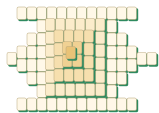
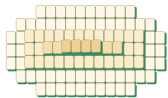
In 1986 Activision released Shanghai, a commercial version of Lockard's game, first for the Macintosh and then for almost every computer and console of the time. It sold very well and made the Turtle the layout most people picture.
Microsoft took it further. Mahjong Titans came with Windows Vista and Windows 7, which put the game on millions of home computers next to Solitaire and Minesweeper. When Windows 8 arrived without it, a lot of people went looking for it online. That is a big reason free Mahjong websites exist at all.
Mahjong today
The two games now live in different worlds. Four-player Mahjong is a serious game with professional leagues in Japan, official tournament rules in China, and an important social role across East Asia. Mahjong Solitaire is one of the most played casual puzzles on the internet, alongside Solitaire and Sudoku.
What still joins them is the set of 144 tiles, with symbols that go back to Chinese money cards. You can play the solitaire version here, read the rules of both games, or look at the tiles themselves.
Questions people ask
Where did Mahjong come from?
China. It most likely took shape in the second half of the 1800s, around Ningbo and the lower Yangtze. It grew out of older Chinese card games that used money suits, which is where the dots, bamboo and characters come from.
How old is Mahjong?
About 150 years. The story that Confucius invented it around 500 BC was made up in the 1920s to sell sets in the West. There is no evidence for it.
Who invented Mahjong Solitaire?
Brodie Lockard wrote it in 1981 on the PLATO computer system and called it Mah-Jongg Solitaire. Activision released it as Shanghai in 1986, and that is how most people first played it.
Why is Mahjong Solitaire called Mahjong?
Because it uses Mahjong tiles. The two games share the tile set and nothing else, and the shared name has confused people ever since.
Was Mahjong ever banned?
Yes. After 1949 the government of the People's Republic of China banned it, mainly because of gambling. It was allowed again in the mid-1980s and is now played all over China.