Mahjong Solitaire Mahjong rules
Mahjong rules
There are two games called Mahjong, and they have almost nothing in common apart from the tiles. This page covers both.
Mahjong is a game for four players that started in China in the 1800s. You draw and throw away tiles to build a winning hand.
Mahjong Solitaire is a puzzle for one player, invented in 1981. You clear a stack of tiles by taking away matching pairs. The game on this site, like nearly every "Mahjong" game online, is Mahjong Solitaire.
Mahjong Solitaire rules
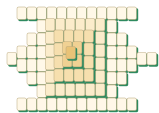
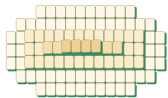
- All 144 tiles are stacked face up in a layout, such as the Turtle.
- A tile is free if nothing sits on top of it and its left or right side is open.
- You may remove two free tiles that show the same face.
- Any flower matches any flower. Any season matches any season. Every other tile needs an exact match.
- Clear all 72 pairs to win. If no free pair is left, you are stuck unless you shuffle.
That is the whole game. There is no scoring, no turns and no opponent. The how to play guide explains it with pictures.
Play Mahjong SolitaireFour-player Mahjong rules
The traditional game is played by four people around a square table. The rules change a lot from place to place. Chinese, Hong Kong, Japanese, Taiwanese and American Mahjong all differ. What follows is the part they share.
Setting up
- The 144 tiles are shuffled face down and built into four walls, each 18 tiles long and two tiles high.
- Each seat is given a wind: East, South, West or North. East is the dealer.
- Everyone takes 13 tiles. East takes a 14th and starts.
Taking a turn
- Draw a tile from the wall, so you have 14.
- Throw one tile face up into the middle, so you have 13 again.
- Play passes to the next player on the right, unless someone claims the tile you threw.
Claiming a tile
If the tile someone throws away would complete a set in your hand, you can call for it and take it, even if it isn't your turn. You then lay that set face up in front of you, and it can't be changed. If two players want the same tile, a winning hand beats a Pung or Kong, and a Pung or Kong beats a Chow.
Winning
A normal winning hand is four sets and one pair, 14 tiles in all. You win the moment your hand is complete, either from a tile you drew or from one you claimed. Flowers and seasons are bonus tiles. When you draw one, you put it to one side, it adds to your score, and you draw another tile to replace it.
Chow, Pung and Kong
| Set | What it is | Example | Who you can claim it from |
|---|---|---|---|
| Chow | Three tiles in a row, one suit | 4, 5, 6 of bamboo | Only the player just before you |
| Pung | Three identical tiles | Three red dragons | Anyone |
| Kong | Four identical tiles | Four east winds | Anyone. You then draw an extra tile. |
| Pair | Two identical tiles | Two 9 of dots | Only to finish a winning hand |
Winds and dragons have no numbers, so they can only make Pungs, Kongs and pairs, never Chows.
Scoring and regional versions
Scoring is where the versions differ most. The general idea is that harder hands score more. A hand all in one suit, all Pungs, or made only of winds and dragons scores far more than a mixed hand of easy runs.
| Version | Where | Hand | What makes it different |
|---|---|---|---|
| Hong Kong | Southern China and overseas Chinese communities | 13 tiles | Simple scoring. The usual starting point for new players. |
| Chinese Official | Mainland China and tournaments | 13 tiles | 81 named scoring patterns and a minimum of 8 points to win. |
| Riichi | Japan | 13 tiles | You can declare you are one tile away, bonus "dora" tiles, and usually no flowers. |
| Taiwanese | Taiwan | 16 tiles | Bigger hands of five sets and a pair. |
| American | United States | 13 tiles | A card of allowed hands printed each year, jokers, and a tile swap called the Charleston. |
If you want to learn to play with friends, Hong Kong rules are the easiest place to start.
The two games side by side
| Mahjong | Mahjong Solitaire | |
|---|---|---|
| Players | 4, sometimes 3 | 1 |
| Where and when | China, second half of the 1800s | United States, 1981 |
| Tiles you can see | Your own hand and the discards | All 144, face up |
| Goal | Build four sets and a pair | Remove every tile in pairs |
| Luck | A lot. Tiles are drawn face down. | Little. You can see the whole board. |
| How long | An hour or more per session | 5 to 20 minutes per board |
The history page explains how the puzzle ended up with the older game's name.
Questions people ask
What are the basic rules of Mahjong?
Four players each hold 13 tiles. On your turn you draw a tile and throw one away, trying to build a hand of four sets and a pair. You can also claim the tile another player throws away if it completes a set. The first player with a complete hand wins the round.
How many tiles do you start with in Mahjong?
Each player starts with 13 tiles. The dealer takes a 14th and throws one away to begin. After that, every turn is draw one, throw one.
What are Chow, Pung and Kong?
A Chow is three tiles in a row in one suit, like 4, 5 and 6 of bamboo. A Pung is three identical tiles. A Kong is four identical tiles. You can only claim a Chow from the player just before you, but you can claim a Pung or Kong from anyone.
Is Mahjong luck or skill?
Both. The tiles you draw are luck. Choosing which hand to aim for, what to throw away, and when to claim a tile are skill, and good players win far more often over a long session.
Are Mahjong Solitaire rules the same as Mahjong rules?
No. Mahjong Solitaire only borrows the tiles. There are no hands, no discards and no scoring. You simply remove matching pairs of free tiles until the board is empty.