Is Mahjong good for your brain? What the research says
People often tell us they play Mahjong Solitaire to “keep the brain ticking over”. It is a fair question whether that works. There is real research on Mahjong and the brain, more than for most games, but most of it is about the four-player game rather than the solitaire version. Here is what the studies actually found.
The short answer
Probably yes, a little, and in the ways you would expect. In two trials, people who played Mahjong regularly kept their memory better than people who didn’t, and in one large survey they were less likely to feel low. But the best evidence is for four-player Mahjong, which is also a social game, and no study has shown that any game prevents dementia. Mahjong Solitaire exercises some of the same skills. It is a good habit, not a medicine.
What the studies found
Mahjong in nursing homes. The best-known trial was run in Hong Kong by Sheung-Tak Cheng and colleagues and published in the American Journal of Geriatric Psychiatry in 2014. 110 nursing home residents with mild to moderate dementia played Mahjong, did tai chi, or did simple handicrafts, three times a week for 12 weeks. Nine months later the handicraft group had declined, while the Mahjong group had held steady. On a standard test of memory and thinking, the MMSE, they scored 4.5 points higher on average. Tai chi helped too, slightly less. The same team reported that the Mahjong players’ overall decline was slower, in a second paper.
Mahjong and mood. In 2019 researchers from the University of Georgia and Huazhong University looked at survey data from nearly 11,000 people aged 45 and over in China. People in cities who played Mahjong regularly were less likely to report depression. In the countryside there was no link, and the authors suspect that is because the game there is often played for money. This kind of study shows a link, not a cause. Happier people may simply play more.
Mahjong on a tablet. A small trial in Taipei, published in JMIR Aging in 2026, gave 30 adults over 55 a Mahjong app to play twice a week for six months. They improved more than a group who didn’t play on one memory measure, delayed recall, and nothing else. The trial was small and the players were also given a walking target, so it is hard to say how much was the Mahjong.
What about Mahjong Solitaire?
We could not find a study of Mahjong Solitaire itself. The closest is the PROTECT study from the University of Exeter and King’s College London, which followed more than 19,000 people over 50. Those who did word and number puzzles more often scored better on tests of attention, reasoning and memory, in some tests like people eight to ten years younger. The researchers were careful to say this does not prove puzzles prevent dementia.
There is also a well-known warning. A 2016 review of brain-training games found that people get better at the game they practise, but there was little evidence that this spreads to everyday life. Getting faster at Mahjong Solitaire mostly makes you faster at Mahjong Solitaire.
That said, a game of Mahjong Solitaire asks for three things the studies above keep coming back to:
- Attention. You scan 144 tiles for a match, often among faces that look alike, like the 2 and 3 of Bamboo.
- Short-term memory. You saw a red dragon a moment ago. Where was it, and was it free?
- Planning. Taking the obvious pair can bury the tile you need later. Good players look a few moves ahead, which is what our strategy guide is about.
How to get more out of it
If you play partly to stay sharp, a few small changes help:
- Play without hints. The hint button does the scanning for you. Save it for when you are truly stuck.
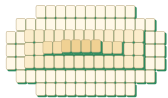
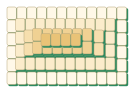
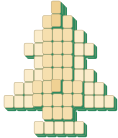
- Move up a level. Once a layout feels easy, try one of the hard layouts. Fortress and Dragon need more planning than Butterfly.
- Make it daily. The PROTECT results were about how often people played. Our daily Mahjong gives you one new board a day, the same board for everyone.
- Try the four-player game. Most of the research is about real Mahjong, played with three other people. If you have friends who play, it is worth learning. Our Mahjong rules page explains how it works, and this post sets out how it differs from the solitaire game.
Quick answers
Does Mahjong prevent dementia? No study has shown that. Trials suggest regular play may slow decline in some areas, such as memory, in people who already have dementia.
Is Mahjong Solitaire as good as four-player Mahjong? Nobody has compared them. Four-player Mahjong adds talking, reading other players and company, and company on its own is good for older adults.
How often should I play? The studies that found an effect used two or three sessions a week, kept up for months. A game a day is plenty.
And if you mainly play because it is calming, that counts too.