Mahjong Connect vs Mahjong Solitaire
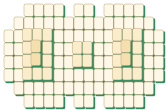
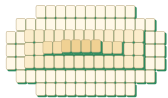
Mahjong Connect is a tile game where you remove two identical tiles by joining them with an imaginary line that turns no more than twice and doesn’t cross any other tile. Mahjong Solitaire uses the same tiles stacked in layers, and you remove a matching pair when both tiles are free: nothing on top of them, and their left or right side open.
Both are one-player matching puzzles, and both are often just called “Mahjong” online. But they play quite differently. You can try Mahjong Solitaire free on our home page, on the classic Turtle layout or any of 23 others.
What are the main differences?
| Mahjong Connect | Mahjong Solitaire | |
|---|---|---|
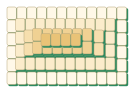
| The board | One flat layer of tiles in a grid | Tiles stacked in layers. The Turtle is five layers high |
| When a pair can go | A line with no more than two turns joins them through empty space | Both tiles are free: nothing on top, left or right side open |
| What you watch | The gaps between tiles | The top of the stack and the ends of each row |
| Hidden tiles | None. Every tile is in view | Many. Tiles under the stack can’t be seen until you clear them |
| Distance | Two tiles can be far apart if a clear path joins them | Distance doesn’t matter, only whether each tile is free |
| Also called | Shisen-Sho, Four Rivers, Onet | Shanghai, Mahjongg, Mahjong Titans |
How do the rules compare?
Here are the two rules side by side, with the same tile pictures in both.
Mahjong Solitaire: take free tiles
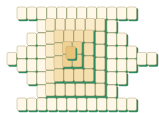
A tile is free when two things are true. Nothing sits on top of it, and at least one of its sides, left or right, is open. Tiles touching it above and below on the same layer don’t count. Click two free tiles with the same face and both disappear.
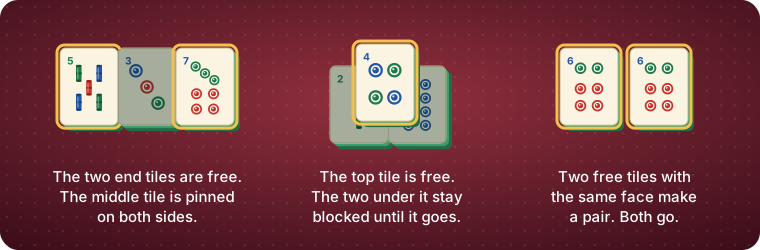
Every pair you take can free the tiles it was covering or pinning, so the board opens up from the top and the edges. Any flower matches any other flower, and any season matches any other season.
Mahjong Connect: join them with a line
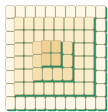
On a Connect board every tile is in view, and none of them is ever “blocked” in the Solitaire sense. What matters is the space between two matching tiles. You can remove them if you can join them with a line that:
- runs only horizontally and vertically,
- passes through empty spaces, never over another tile, and
- turns no more than twice. That means at most three straight sections.
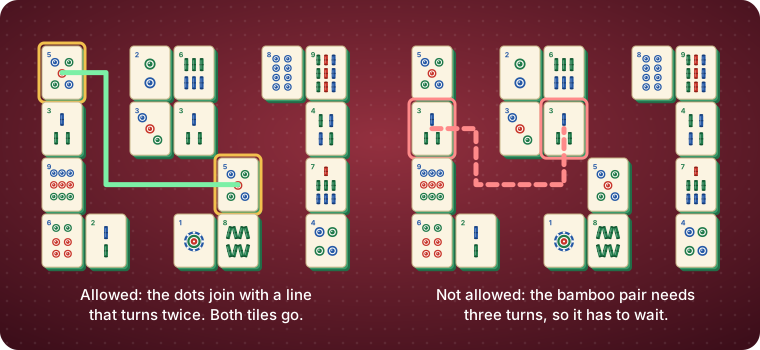
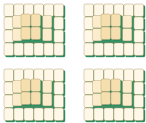
Two matching tiles side by side can always go, because the line between them has no turns at all. Notice in the second board that the bamboo pair sits in the same row, with just one tile between them. It still can’t go until something clears a shorter path.
Some versions add gravity: after each match, the tiles above slide down to fill the gap, so the board keeps changing shape under you.
Which one is harder?
They are hard in different ways.
Mahjong Solitaire is hard because of what you can’t see. On the Turtle, only 35 of the 144 tiles are free at the start. The rest are stacked under or pinned between other tiles. The classic way to lose is to match two copies of a tile while the other two copies are buried one on top of the other, which leaves them with no partner. We explain that trap in Why you keep getting stuck in Mahjong Solitaire.
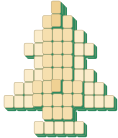
To put numbers on it, our computer player played 200 games on each of our 24 layouts, choosing moves the way our Hint button does. It cleared the Turtle without a shuffle in about 50% of games. The gentle Butterfly came in at about 85%, and the five-level Fortress at only about 20%. So in Solitaire, the shape of the board decides most of the difficulty.
Mahjong Connect is hard because the paths keep changing. Nothing is hidden, so you can plan the whole board if you are patient. But a pair that has a clear path now can lose it after a few more moves, and tiles in the middle of a crowded board can’t reach anything. Some versions also put you against a clock, which turns it into a game of quick scanning more than careful planning.
We haven’t tested Mahjong Connect with our computer player yet, so we can’t give you a fair number for it.
Where did Mahjong Connect come from?
Mahjong Connect grew out of a Japanese game called Shisen-Sho, which means “Sichuan Province”. According to Wikipedia’s list of releases, arcade versions go back to 1989, and it has since been made for many computers, consoles and phones.
Mahjong Solitaire is a little older. Brodie Lockard wrote it in 1981, and Activision released it as Shanghai in 1986. Our history of Mahjong tells that story, from the four-player game in 1800s China to Mahjong Titans on Windows.
Neither game has much to do with real four-player Mahjong, apart from the tiles.
Can you play Mahjong Connect here?
Not yet. This site has Mahjong Solitaire today, with 24 layouts, six Christmas layouts and a daily board that everyone shares. Mahjong Connect is the next game we are adding, and it will follow the same rules as this site: free, no download, and every board dealt so it can be cleared.
Which should you play?
Mahjong Connect suits you if:
- you like spotting things fast, the way you would in a word search,
- you want everything in view, with no hidden tiles to worry about,
- you enjoy a timer, or a board that changes shape as you play.
Mahjong Solitaire suits you if:
- you like to take your time and plan a few moves ahead,
- you enjoy the moment a buried tile finally comes free,
- you want a choice of board shapes, from easy to properly hard,
- you played Mahjong Titans or Shanghai and want that same game back.
If you are not sure, start with Solitaire on an easy layout like Butterfly, then try the Turtle. Play Mahjong now, free in your browser, with nothing to download.
Questions people ask
Is Mahjong Connect the same as Shisen-Sho?
Yes. Shisen-Sho is the Japanese name, and the rules are the same: join two matching tiles with a line of no more than two turns that doesn't cross another tile. It is also sold as Four Rivers, and in app stores you will often see it called Onet.
Can the line go round the outside of the board?
In many versions, yes. The line can leave the board, run along the empty edge and come back in, which makes tiles on the outside much easier to join. Check the rules of the version you play, because not all of them allow it.
Do flowers and seasons match in Mahjong Connect?
It depends on the version. A real Mahjong set has only one of each flower and season, so they are usually matched within their group, as in Mahjong Solitaire. Some computer versions use identical copies instead, so each flower needs its exact twin.